802.11ah / Wi-Fi HaLow · Pre-production

IP connectivity across the parts of your operation that fiber and cellular never reached.

A ruggedized sub-1 GHz access point built for outdoor industrial deployment: about 1 km of coverage, 1,000+ battery-powered endpoints per unit, PoE powered, -40 °C to +85 °C, designed and manufactured in the United States — and engineered from the start for Class I Division 2 areas.

Status: pre-production hardware. Certifications listed on this page as "in certification" or "targeted" have not been issued. No certification mark is claimed.

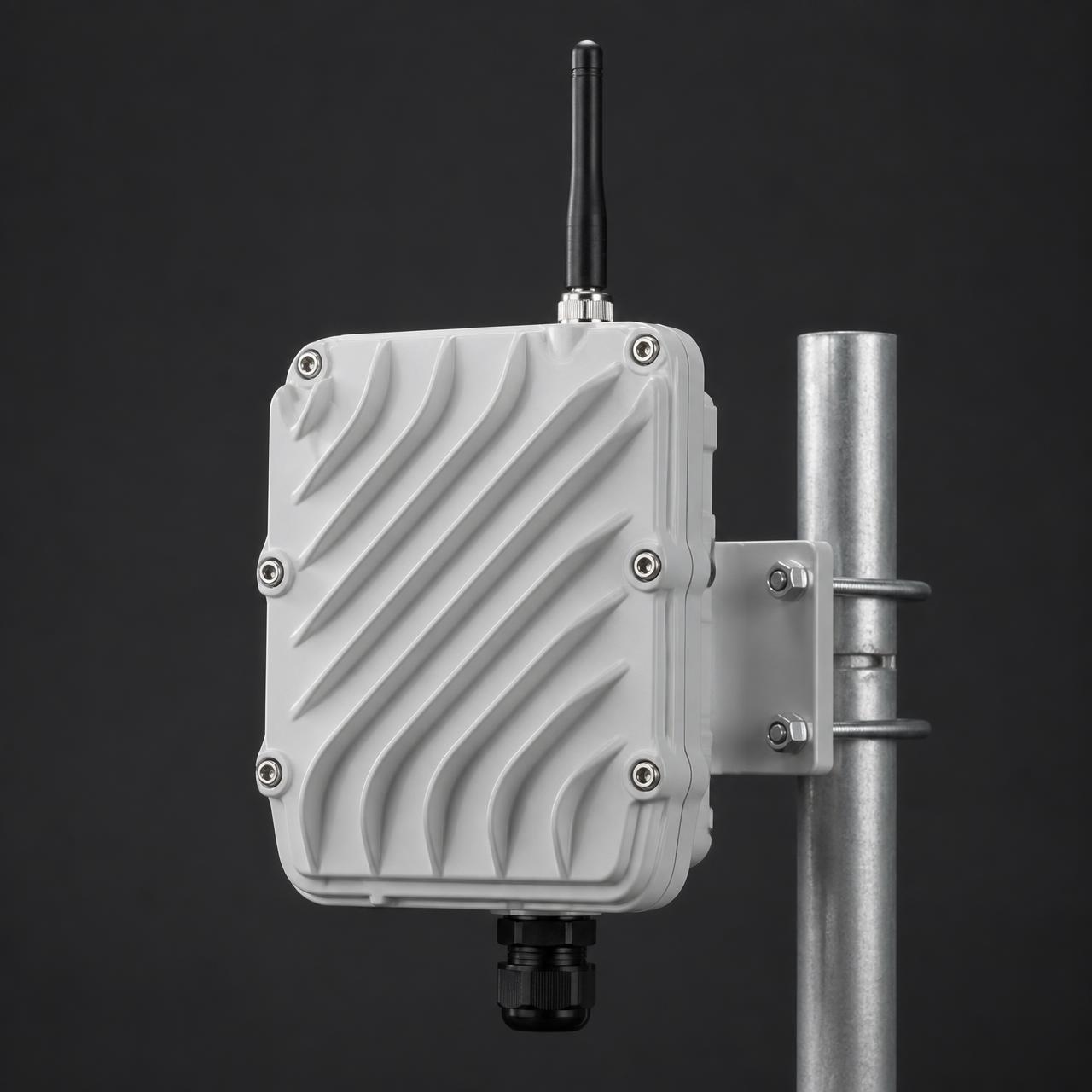
Texas HaLow ruggedized 802.11ah outdoor access point mounted on a galvanized mast

01 — The gap

Your control system needs IP. Your acreage does not have any.

SCADA, PLCs and IIoT sensors all speak IP. Getting IP to a wellhead 4 miles down a lease road, or to 400 soil probes on a 5,000-acre farm, currently means one of three bills: trenching fiber at highway-project prices, paying a monthly line per device on cellular across thousands of endpoints, or leasing satellite bandwidth by the gigabyte.

All three are expensive to install and expensive to keep alive across hundreds of square miles of remote land — and two of them put a battery or a solar panel maintenance visit behind every single sensor.

The alternative

200+

acres covered by one access point

1,000+

associated endpoints, on batteries that last years between site visits

$0

recurring per-device airtime cost on your own spectrum-license-free network

02 — How HaLow works, and what it costs you

Sub-1 GHz buys range and battery life. It does not buy bandwidth.

802.11ah runs in the 902–928 MHz ISM band in the US. Lower frequency means lower path loss and better penetration through terrain, crop canopy, steel structures and tank farms than 2.4 or 5 GHz. Narrow channels — 1, 2, 4 and 8 MHz — concentrate the same transmit power into less spectrum, which is why a link closes at a kilometer instead of a hundred meters.

It is still Wi-Fi: standard IP, standard WPA3, standard tooling. Your sensor gets a DHCP address and talks Modbus TCP or MQTT like anything else on the network.

Honest tradeoff

  • Throughput is tens of Mbps at best, shared, and drops toward hundreds of kbps at the edge of the cell. This is a telemetry and control network.
  • It will not carry a wall of HD video. One or two low-frame-rate inspection cameras per AP is realistic. A 16-camera site is not.
  • Range is line-of-sight dependent. 1 km typical; ridge lines, deep metal structures and heavy canopy will cut it. We will tell you that during the site review rather than after the PO.

03 — Why this access point

Every other HaLow AP on the market today is consumer or light-commercial hardware. None of them is built for a classified area.

01In certification

Hazardous location, by design

Engineered to Class I Division 2 / UL 121201 requirements for wellhead, tank battery and compressor-station mounting. Certification is in progress — we will publish the file number and listing the day it is issued, and not before.

02US-built

Designed and manufactured in the USA

Board design, firmware and final assembly in the United States. Intended for TAA-compliant procurement and Section 889 clean bills of materials. Component-level country-of-origin documentation provided on request.

03OpenWrt

Open firmware

OpenWrt-based. Full root over SSH, standard package management, no license keys, no cloud dependency, no subscription required to read your own sensors. Build and flash your own image if you prefer.

04Schematics published

Right to repair

Published schematics and board files, documented connectors and part numbers, field-replaceable modules. Gasketed and bolted enclosure — no adhesive, no destructive disassembly.

053 module bays

Modular architecture

Radio, compute and I/O are separate cards on a documented internal bus. Swap the radio module for a new band plan or a newer HaLow silicon revision without pulling the deployed unit off the mast.

04 — Specifications

SI-AH1 outdoor access point

Preliminary datasheet · Rev C · Values subject to change before production release

Standard
IEEE 802.11ah (Wi-Fi HaLow)
Frequency
902–928 MHz ISM (US band plan)
sub-1 GHz
Channel widths
1 / 2 / 4 / 8 MHz
Range
1 km typical line of sight at 2 MHz
≈200+ acres per AP
Throughput
150 kbps – 32 Mbps, rate dependent on channel width and distance
not video-grade
Associated devices
1,000+ per access point
8,191 AID ceiling
Backhaul
1x 10/100/1000 Base-T, sealed M12 or gland-entry RJ45
Power
802.3af/at PoE, 9 W typical / 15 W peak
48 VDC nominal
Operating temperature
-40 °C to +85 °C
no heater required
Ingress / impact
IP67 sealed, targeted IK08
UV-stable enclosure
Enclosure
Die-cast aluminum, powder coat, gasketed and bolted
Mounting
2–4 in mast U-bolt, wall plate, or DIN rail with adapter
Dimensions
224 × 178 × 76 mm (8.8 × 7.0 × 3.0 in), 1.9 kg
Antenna
N-type female, 3 dBi omni included; sector and yagi supported
Firmware
OpenWrt, root access, signed images optional
Certifications
FCC Part 15.247 — in certification. UL 121201 Class I Div 2 — targeted. No mark is claimed until issued.
pre-production

05 — Where it gets deployed

Wellsite telemetry

Pump-off controllers, tank level, pressure and flow transmitters, and RTU serial gateways reporting back to SCADA over a single AP at the tank battery instead of a cell modem per pad.

  • — Modbus / DNP3 over IP
  • — Class I Div 2 area mounting
  • — No per-device data plan

Precision agriculture

Soil moisture probes, weather stations, pivot and valve controllers, grain bin sensors and equipment trackers across a section of land, backhauled from one mast at the shop.

  • — Multi-year battery endpoints
  • — Coverage past the treeline
  • — Works where LTE is one bar

Remote asset monitoring

Pipeline cathodic protection, valve stations, water districts, mine sites and substations — anywhere fiber trenching and satellite bandwidth are the only quotes on the table.

  • — 1 km per hop, repeatable
  • — PoE from existing panel
  • — Deterministic ownership cost

06 — Against the other quotes on your desk

Honest comparison

CriterionHaLow APCellular per deviceSatelliteTrenched fiber
Install cost across 200 acresOne mast, one PoE dropModem per endpointTerminal per site$$$ per mile trenched
Recurring costNonePer-device per monthPer-GB or committed planNone after build
Endpoint battery lifeYearsMonths, or line powerLine powerN/A
ThroughputTens of Mbps sharedHighModerate, high latencyVery high
Hazardous location ratingTargeted Cl I Div 2Varies by modemRarely ratedConduit dependent
Works without carrier coverageYesNoYesYes
Supply chain / TAAUS-builtMixedMixedN/A

Consumer-grade HaLow hardware is the fifth option and is genuinely cheaper per unit. It is also unrated for classified areas, typically sealed shut, firmware locked, and sourced offshore. If your site is not classified and your procurement has no origin requirements, it may be the right call.

07 — Open by design

Firmware you own

OpenWrt with a documented build tree. SSH root, opkg, standard config files. Run your own MQTT broker, Modbus gateway or edge script on the unit. No license server, no activation, no cloud account required to operate the radio you bought.

Hardware you can fix

Schematics, board dimensions, connector pinouts and a parts list are published. Gaskets, glands, surge modules and the antenna pigtail are orderable individually. A field tech with a hex driver can restore a unit without an RMA.

Modules you can upgrade

Radio, compute and I/O are separate cards. A new HaLow silicon revision or a different band plan is a module swap on the mast, not a truck roll with a new enclosure and a new mounting survey.

08 — Design partner program

We are pre-production and taking a limited number of field sites.

Design partners get evaluation units, direct access to the engineers who wrote the firmware, and input on the I/O module roadmap. In exchange we ask for a real deployment, real RF conditions, and honest failure reports. If you need certified units in hand today, tell us your date and we will tell you plainly whether we can meet it.

What to send us

  • — Site type and area classification, if any
  • — Approximate coverage area and terrain
  • — Endpoint count, protocol and reporting interval
  • — Backhaul available at the mast
  • — Procurement requirements (TAA, 889, DFARS)

We will respond with a link budget and an honest yes or no, not a brochure.